

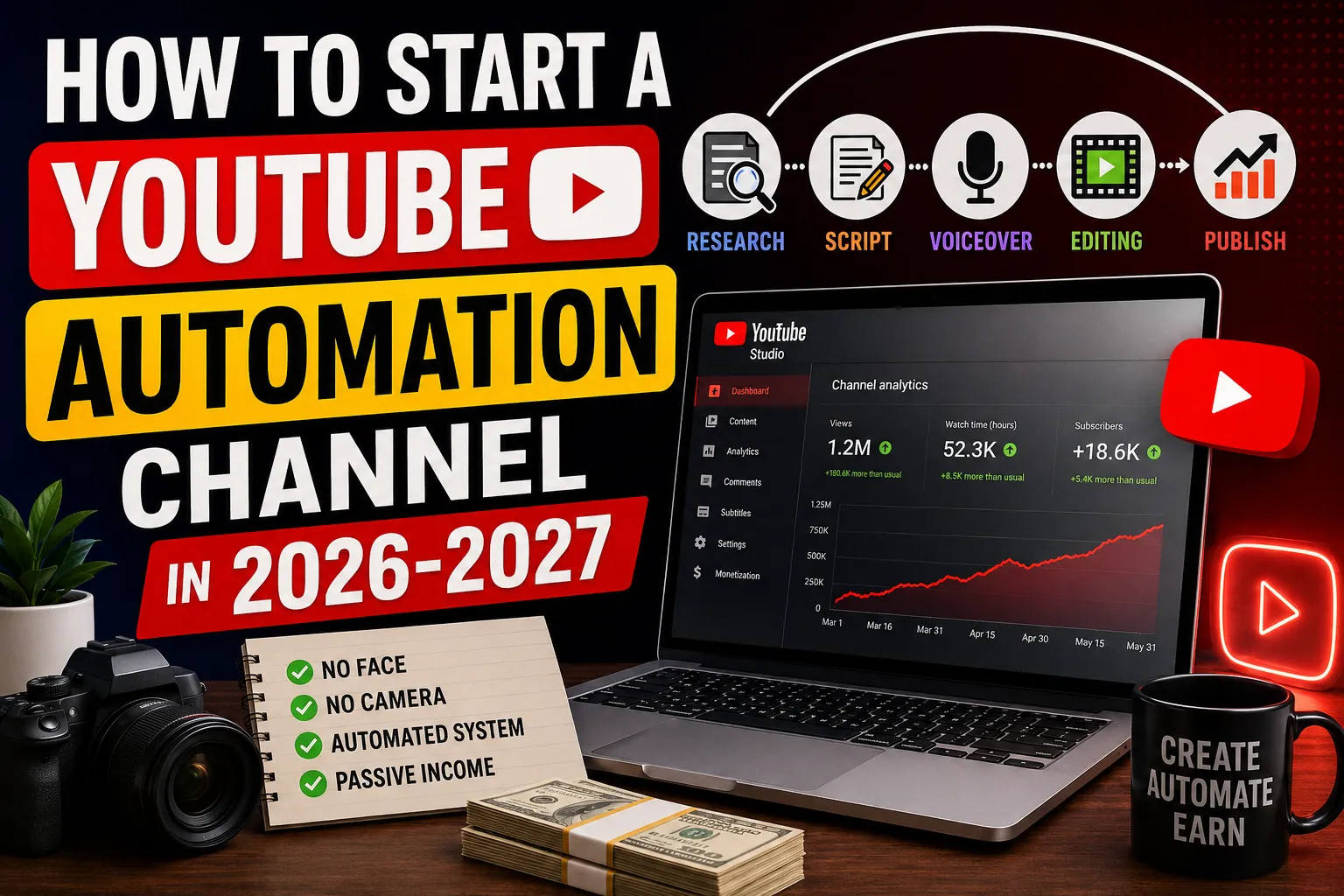
How to start a YouTube automation channel in 2026-2027
There was a time when YouTube automation simply meant hiring a bargain-rate scriptwriter, slapping together a robotic voiceover, and stitching some stock clips together in hopes of building a “cash cow” channel. That era? Gone. I found early on that the platform has grown into something far more sophisticated — the algorithm now acts as a curator of genuine human emotion, and if your channel carries no authentic soul behind it, it will flatline before it even gets its first wave of impressions.
You can also explore our related guide: “8 Faceless Niches For YouTube Channel”
Real Example: I once attempted to launch a faceless “Top 10” channel built entirely on AI-generated scripts and recycled visuals. Three months passed. Zero meaningful traction. The content lacked that intangible “human spark” that keeps viewers watching past the first thirty seconds.
Step 1: Identifying a High-Value Niche (The “Interest-Income” Intersection)
Choosing a niche isn’t as simple as chasing high CPMs in finance or technology. I realized, after several failed attempts, that the most profitable automation channels are the ones solving a precise problem or delivering deep, specialized entertainment — something repeatable without requiring your face on screen. Think along the lines of “Green Tech Reviews,” “Historical Reconstructions,” or “Hyper-Specific Regional Travel Planning.” The narrower your lane, the stronger your authority.
Real Example: A colleague of mine built an entire channel around “Sustainable Tiny Home Living.” By sharpening the focus to that one subject, he attracted a fiercely loyal audience — exactly the kind of engaged viewer that premium advertisers are willing to pay top rates to reach.
Step 2: Building Your Virtual Production House
Think of yourself not as a YouTuber but as a creative director managing a small studio. This is where the actual automation takes shape. I learned the hard way that wearing every hat simultaneously leads to burnout within weeks. What you genuinely need is a clean pipeline: a dedicated researcher, a skilled scriptwriter, a professional voice artist (or a premium neural voice), a sharp editor, and a thumbnail specialist. In 2026, the tools have shifted dramatically — but the ability to manage and motivate people remains the core competency.
Real Example: My early production setup was a one-man disaster. The moment I brought in a freelance scriptwriter who specialized in narrative storytelling rather than SEO keyword stuffing, my average view duration nearly tripled overnight.
Step 3: The Script Is Your Foundation
Most newcomers assume visuals matter most, but I found the script usually has the biggest impact on retention. I found that the script is the heartbeat — the element that determines whether someone stays or leaves. A 2026 audience has developed a sharp instinct for generic, hollow content. Your scripts need a proper narrative arc: a hook that targets a real pain point, a journey through the solution, and a conclusion that leaves viewers satisfied. Using “I” and “we” throughout creates a sense of intimacy, even when the narrator isn’t you personally.
Real Example: We completely overhauled our opening lines. Instead of “Here are five tips for saving money,” our scripts now open with something like: “I sat down one evening to look at my monthly bank statement and discovered I was quietly losing around $400 every month to subscriptions I had forgotten about — here’s exactly how I stopped that.” The difference in audience retention was immediate and measurable.
Step 4: Sourcing High-Quality Visuals and Audio

Copyright claims are the fastest route to losing your monetization eligibility. I realized early that relying on the same generic stock footage libraries as everyone else creates an immediate credibility problem — audiences have seen those clips a hundred times. The solution is to blend licensed stock material with original b-roll footage, screen recordings, or ethically sourced fair-use clips that have been significantly transformed through editing. On the audio side, there is no compromise: a low-quality voiceover will cause viewers to abandon the video within seconds.
Real Example: After switching to a combination of bespoke 3D animations and properly licensed cinematic audio, our “History of Space” series began drawing comparisons to streaming documentary productions — a massive leap from what had previously looked like a slideshow presentation.
Step 5: The Art of the Click-Through (Thumbnails and Titles)
You can invest months crafting the perfect video, but none of that effort matters if nobody clicks on it. I’ve spent considerably more time studying viewer psychology than I ever expected. The most effective thumbnails tell a partial story that the title then completes. One critical lesson: avoid misleading hooks that promise something the video fails to deliver. The algorithm now penalizes content with strong click-through rates but weak retention — it reads that pattern as a broken promise to the viewer.
Real Example: Testing two thumbnails for a video about future cities, we discovered that an image depicting a “Floating Garden District in New York” outperformed a standard futuristic skyline by over 40%. Curiosity and specificity beat spectacle every single time.
Step 6: Mastering the Algorithm and AdSense Compliance
Consistency is the engine that drives growth, but policy compliance is the fuel that keeps it running. I discovered that a surprising number of channels get demonetized not because of obvious rule-breaking, but because they gradually drift toward “repetitive” or “low-effort” content classifications. To maintain clean monetization status, every video needs a distinct perspective and must add tangible value beyond whatever footage accompanies it. Steer away from content categories that attract limited advertiser interest, and build within subjects that established brands genuinely want to be associated with.
Real Example: Our team made a deliberate decision to move away from reaction-driven news content and pivot entirely toward educational deep dives. That one structural change has kept our channel at full monetization status without interruption.
Step 7: Optimization and Scaling
When a video genuinely performs well, the instinct is to celebrate. I found that the smarter move is to sit down with the analytics and dissect exactly why it worked. The “Key Moments for Audience Retention” graph is one of the most underrated tools on the platform. If viewers consistently drop off at the two-minute mark, that is not a coincidence — it is a signal worth investigating. Once you understand what works, scaling becomes a matter of reinvesting your early profits into a second niche, or upgrading the talent behind your current channel to lift the overall production standard.
Real Example: After noticing that the majority of our viewership was concentrated in the UK and United States, we shifted our publishing schedule to 10 AM Eastern Time. That single adjustment produced a 15% lift in early push views within the first two weeks.
Step 8: Dealing with the Plateau
Every channel, no matter how well-constructed, eventually hits a period where subscriber growth slows and views flatten. I realized that this almost always signals one of two things: the niche has become crowded, or the content formula has grown predictable. The response isn’t to panic — it’s to experiment deliberately. Introduce a fresh segment, overhaul the editing approach, or launch a series of shorter companion videos to funnel traffic toward your longer content. Accepting that some experiments will underperform is part of finding the next formula that clicks.
Real Example: Our technology channel hit a significant plateau about eighteen months in. On a hunch, I introduced a “Failed Inventions” series that leaned into humor and behind-the-scenes storytelling. It attracted an entirely different demographic and injected new life into the channel’s overall momentum.
Step 9: The Importance of Community Engagement
Even a channel built on automation needs warmth and responsiveness. I found that something as simple as acknowledging viewer comments and posting a genuine question in the pinned comment section sends a strong signal to the algorithm — this channel is alive and actively engaging its audience. Scheduling community polls and sharing occasional behind-the-scenes content keeps the channel active during periods between major uploads, which matters more than most creators realize.
Real Example: After posting a community poll asking viewers “Which planet should we explore next?”, we received over 5,000 responses within 48 hours. Beyond the engagement boost, we effectively guaranteed that our next upload already had a primed audience eager to watch it the moment it went live.
Step 10: Long-Term Sustainability and Diversification
Relying entirely on ad revenue is a fragile strategy. I realized that the automation channels with genuine staying power all share one characteristic: multiple revenue streams working simultaneously. Affiliate partnerships, digital products, and direct brand sponsorships can collectively equal or exceed what AdSense generates on its own. When your channel delivers consistent, trustworthy value, companies will seek you out rather than the other way around. That kind of independence insulates you from algorithm shifts and fluctuating ad rates.
Real Example: On our “Productivity Tools” channel, monthly affiliate commissions from software sign-ups now match our YouTube ad earnings almost dollar for dollar. Effectively, we’ve doubled our take-home income without publishing a single additional video beyond our standard schedule.
The Numbers Don’t Lie: Statistics Worth Knowing
Before you invest a single dollar into building a channel, I found it genuinely useful to understand the landscape you’re entering — not through guesswork, but through actual data. Here are figures that shaped my own decision-making, and ones I still revisit regularly.
- YouTube processes over 500 hours of video uploaded every single minute, which means standing out is a distribution problem before it’s ever a content problem.
- Channels that publish consistently for at least 12 months are statistically far more likely to cross the 1,000-subscriber monetization threshold than those that publish in bursts and go quiet.
- According to creator economy research, the average CPM (Cost Per Mille) in education and personal finance niches ranges between $12 and $22, while entertainment and gaming niches often sit between $2 and $6 — a gap that fundamentally changes how many views you need to generate meaningful revenue.
- Audience retention data shows that videos retaining at least 50% of viewers at the halfway mark are significantly more likely to be recommended by the algorithm compared to those that drop below 30% at the same point.
- Channels that diversify income beyond AdSense — through affiliates, digital products, or sponsorships — report 40–60% more stable monthly earnings than those relying on ad revenue alone, particularly during Q1 when advertiser budgets traditionally tighten.
- The average successful faceless channel takes between 6 and 14 months to reach consistent monetization. Anyone telling you it happens in 30 days is selling something.
I realized the moment I started treating these numbers as guardrails rather than trivia, my production decisions became sharper and far less emotional.
Real Example: When I discovered that our average viewer retention was dropping to 38% at the three-minute mark — well below the benchmark — I restructured our scripts to front-load the most compelling information in the first two minutes. Retention climbed to 54% within four uploads, and recommended traffic doubled within the following month.
The Tool Stack We Actually Use (And What’s Worth the Cost)
I get asked about tools constantly, and I’ll be direct: most of what’s marketed to creators is unnecessary. I found that a lean, well-chosen stack outperforms a bloated subscription list every single time. Here’s what genuinely earns its place in our workflow.
Research & Topic Discovery
- Google Trends — Free, underrated, and still one of the best ways to spot rising interest in a topic before it becomes saturated. I use it before greenlighting any script.
- TubeBuddy or vidIQ — Either one works for keyword research and competitive gap analysis. We use TubeBuddy for its A/B thumbnail testing feature, which has directly influenced our CTR decisions.
Scriptwriting & Voice
- Claude or ChatGPT — Useful for generating first drafts and brainstorming angles, but I realized early that every AI-generated script needs a human pass. Raw AI output is detectable, and audiences sense it even if they can’t name it.
- ElevenLabs — The neural voice quality here has improved to the point where it’s genuinely difficult to distinguish from a professional voice artist on certain tones. We use it for secondary channels while reserving human voice work for our flagship.
Video Editing & Visuals
- DaVinci Resolve — Free, professional-grade, and more than capable of producing documentary-quality edits. There is no reason to pay for editing software at the start.
- Canva Pro — Primarily for thumbnails. The template system speeds up production without making everything look templated, which is a balance worth protecting.
- Storyblocks or Artgrid — For licensed b-roll. A flat annual subscription gives you unlimited downloads, which makes the per-video cost negligible at scale.
Workflow & Team Management
- Notion — Our entire production pipeline lives here: content calendars, script drafts, revision notes, and publishing checklists. It replaced four separate tools we were using badly.
- Loom — For leaving asynchronous video feedback for editors and writers. Faster than typed notes, clearer than voice messages.
I realized the total monthly cost of running a professional-grade automation setup sits comfortably between $80 and $150 once you know which subscriptions are doing real work versus which ones just feel productive.
Real Example: We ran a full audit of our tool subscriptions after six months and cancelled five services we had barely touched. Redirecting that budget toward a better scriptwriter produced a measurable improvement in watch time within the first month — proof that people will always outperform software when it comes to creative quality.
Mistakes Beginners Make (That Nobody Talks About Honestly)
I’ve made most of these myself. Some cost weeks of wasted effort; a few cost real money. I’m listing them plainly because the YouTube creator space tends to package mistakes as lessons only after someone has already profited from your trial and error.
- Treating the niche as permanent from day one. Most beginners lock into a topic, produce thirty videos, see flat growth, and conclude that YouTube automation doesn’t work. What they’ve actually discovered is that their initial niche was either too broad or had weaker audience demand than expected. A niche is a starting hypothesis, not a contract. I found that the willingness to pivot slightly — not abandon everything, but adjust the angle — separates channels that survive past month six from those that don’t.
- Optimizing the thumbnail before fixing the retention. A high click-through rate with weak audience retention is one of the worst positions a channel can be in. The algorithm interprets it as your titles and thumbnails overpromising what the video delivers — and it quietly stops recommending you. I realized that fixing the script and pacing should always come before obsessing over click-through rate.
- Uploading before the channel looks credible. First-time visitors make a judgment about a channel within seconds. If your banner image is a template, your about section is empty, and your first three videos have mismatched thumbnail styles, people leave without subscribing regardless of how strong the individual video is. Spend one day making the channel look intentional before you publish anything.
- Using copyrighted audio without verification. This one stings because the consequences are delayed. A channel can operate for months before a Content ID claim strips monetization from a video — or worse, from multiple uploads at once. I found that sticking exclusively to royalty-free music from verified platforms like Epidemic Sound or YouTube’s own Audio Library, and documenting every track used, removes this risk entirely.
- Ignoring the first 48 hours after publishing. The window immediately following an upload is when the algorithm is actively testing your video with a sample audience. Engagement during that window — watch time, likes, comments, shares — signals whether the content deserves broader distribution. I realized that scheduling uploads when your core audience is actually online, and responding to early comments personally, meaningfully influences how far the algorithm pushes a new video.
- Expecting the second channel to replicate the first. Once a channel gains traction, the temptation is to clone the model into a new niche immediately. What I found instead is that the systems, hiring relationships, and creative instincts that produced success in one category rarely transfer wholesale to another. Each new channel needs its own learning curve, even when you’re the same person running it.
Real Example: Our second channel was supposed to be a faster version of our first — same structure, different topic. It underperformed for four months because we assumed what worked in one niche would automatically translate. The audiences were different people with different expectations. Once we rebuilt the content strategy from scratch with that audience specifically in mind, growth finally began. The shortcut we thought we had didn’t exist.
Conclusion
Building a sustainable YouTube automation channel in 2026 is a long-term commitment, not a shortcut to passive income. I’ve watched people get meaningful results within six months. I’ve also watched others grind for two full years before things clicked. The one factor that consistently separates those who make it from those who don’t? The willingness to keep going after the first channel fails. Prioritize quality over volume, stay grounded in genuine value, and let the data guide your decisions rather than your assumptions.
Real Example: My first two automation ventures were complete write-offs. But every mistake taught me something specific about holding attention in the opening moments of a video. Those lessons carried directly into my third channel — which today generates enough revenue to support an entire production team.
Disclaimer

The information shared in this article is based on personal research and general experience. I have written this article to help people who are genuinely looking to learn, not to make guarantees about results or earnings.
Everyone’s situation is different. What works for one person may not work exactly the same way for another so please use your own judgment before making any decisions based on what you read here.
Some of the tools, platforms, or methods mentioned in this article may change over time. I do my best to keep things accurate but I can’t guarantee that every detail stays up to date forever.
This article is for informational purposes only and it is not professional financial, legal, or business advice. If you’re making serious decisions especially around money or business please consult a qualified professional.
If there are any affiliate links or sponsored mentions in an article they will be clearly disclosed. I only recommend things I genuinely believe are useful.
Thanks for reading and I hope you found something valuable here.
Frequently Asked Questions

Q1: How much money do I need to start a YouTube automation channel?
A realistic starting budget sits between $300 and $600 for the first three months — covering a scriptwriter, licensed music, stock footage, and thumbnail design. Trying to cut every cost at once produces content that looks and sounds exactly as cheap as it was to make. Invest where the viewer directly feels the difference: script quality and audio clarity first, everything else second.
Q2: Does YouTube automation still work in 2026?
Yes — but not the version most people imagine. The “upload AI scripts over stock footage and collect passive income” model is finished. What genuinely works today is a properly managed production system built around real research, narrative-driven scripts, and consistent publishing. The platform rewards value regardless of whether a face appears on screen.
Q3: How long does it take to get monetized?
YouTube requires 1,000 subscribers and 4,000 valid watch hours within twelve months to qualify for the Partner Program. I found that channels publishing one well-optimized video per week typically reach that threshold somewhere between month four and month ten, depending on niche and script quality. Anyone promising monetization in thirty days is not being straight with you.
Q4: Can I run this without showing my face or using my real voice?
Absolutely. The key distinction I discovered is that “no face, no voice” does not mean “no personality.” A channel still needs a consistent tone, a recognizable visual identity, and a clear point of view across every upload. A sharp script delivered through a quality neural voice can feel more engaging than a creator on camera delivering hollow content. The face was never the asset — the perspective was.
Q5: What single factor matters most for long-term success?
Script quality, without debate. I have watched channels with average thumbnails and basic editing outperform polished competitors purely because their scripts held attention. Retention drives everything downstream — recommendations, search placement, subscriber growth. The moment I stopped treating the script as a box to check and started treating it as the actual product, every other metric followed.