
How to Get Your First Content Writing Job (What Nobody Tells You at the Start)
There is a specific kind of frustration that hits when you open a content writing job listing, and the first line reads: “minimum two years of experience.” You close the tab. Open another. Same thing.
Three weeks of that. Same result every time.
What changed things was not a course or a certificate. One simple question finally broke the cycle: What does a client actually need from a writer they have never worked with before? The answer was simpler than expected. They need someone who makes their audience feel understood. No awards required. Just clear, useful writing.

Content Writing Is Not One Thing
Most beginners picture blog posts and nothing else. That is a small slice of a much larger market.
Businesses need website copy, product descriptions, email newsletters, how-to guides, and landing pages. Each format requires a slightly different skill. A product description needs persuasion in fifty words. A how-to guide needs patience and logical steps. A newsletter needs warmth.
Writers who struggle the longest are usually the ones applying to everything without any real direction. Pick one or two formats. Get genuinely good at them. That focus moves you forward faster than dabbling in everything at once.
Once you start getting consistent client work, the next challenge is increasing your income. If you’re interested in turning content writing into a reliable source of earnings, you may also want to read our guide on How to Earn Money by Content Writing, which covers common income paths, pricing strategies, and ways to grow beyond beginner rates.
Close the Skill Gap Before Chasing Clients
Most people browse job boards before their writing is actually ready. That instinct costs weeks.
The biggest quality gap in beginner writing is not grammar. It is structured. Knowing when to end a paragraph, when a short sentence lands harder than a long one, and when to slow down and explain something properly. That sense of pacing comes from reading and writing consistently, not from any tool.
One exercise worth trying: take a published article you admire and rewrite the same information completely from scratch without looking at the original. No copying. Just rebuilding the argument in your own words. Do that five times across different styles and your instincts sharpen noticeably. Structure gets absorbed the same way a musician absorbs rhythm, through repetition with attention.
Portfolio Samples: Topic Selection Matters More Than You Think
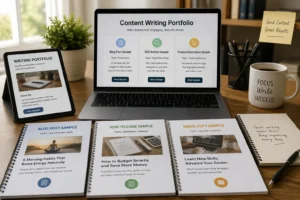
The standard advice is to write three to five samples. Fine. But what you write about matters as much as how you write it.
Weak sample topic: “Why Reading Is Good for You”
Stronger sample topic: “Reading Habits That Help People in High-Pressure Jobs Stay Focused”
The second one signals audience awareness. A client running a productivity platform sees that title and immediately thinks: this writer understands our readers.
Many new writers make the same early mistake of writing about whatever personally interests them. The articles are decent but pointed at nobody in particular. Writing with one real person in mind, thinking about their actual Tuesday afternoon problem, tightens the copy immediately.
Pick topics in niches with real commercial demand. Health, personal finance, career development, and home improvement all have businesses that need regular content and tight budgets, which means they are often open to newer writers.
SEO Basics Worth Knowing Before Your First Application
Ignore most of the technical noise around SEO at the start. What actually affects your writing comes down to three things.
Search intent. When someone types “how to sleep faster,” they want practical tips, not a history of sleep science. Match what you write to what the reader is actually looking for.
Headings structure the page. Clear H2 and H3 headings make articles easier to read and easier for search engines to understand. They are not decoration.
Readability keeps people on the page. Short sentences, active voice, plain language. Search engines notice when people stay and read versus immediately leaving.
The fastest way to internalize this: pick any search term, read the top three results, and ask what they all have in common. That pattern is the intent. Write something that answers it more clearly.
You Do Not Need a Website to Start
A shared Google Doc with two or three samples linked inside is a perfectly functional portfolio for your first few applications. What matters is that whoever opens your link can read a full article in under two minutes and form a clear impression of how you write.
If you want a free web presence, Medium or a basic WordPress site works well. Publishing there also gives you URLs to share instead of attachments, which feels cleaner in a pitch.
Over time a personal domain signals that you take the work seriously. But in the first few months, writing quality earns responses, not platform polish.
Where to Actually Find Work as a Beginner
Job boards are the most competitive surface for new writers. Hundreds of people apply to the same listing. The odds are not great at the start.
What works better:
Direct outreach to small businesses. Find a local or niche business with thin or outdated website content. Write a short, specific note about what you noticed and what you could improve. It feels uncomfortable at first. It works far better than cold applications.
Content agencies. Many agencies hire beginner writers at modest rates and assign work with clear briefs. The pay is lower, but the structure teaches you how real content workflows operate: briefs, drafts, revisions, style guides. That operational experience is worth more than the income at that stage.
Freelance platforms. These work but require patience. A profile with a clear niche and one or two solid samples performs better than a generic “I write anything” bio.
LinkedIn is another platform worth exploring. Many companies post content writing opportunities directly on their company pages, often before listing them elsewhere. If you’re new to the platform, check out our complete guide on How to Find a Job on LinkedIn.
Application Messages That Actually Get Read
Most pitches look like this: “Hi, I am a passionate writer with strong communication skills and I would love to work with your team.”
That could have been sent by anyone, to anyone, about anything.
What a better message does: it mentions something specific about the company, explains briefly what you write, attaches one relevant sample, and ends with a clear offer rather than “let me know if interested.” The whole thing takes ninety seconds to read. Clients who are hiring are overwhelmed. A message that shows thirty seconds of genuine research stands out immediately.
The First Project Will Surprise You
The first paid assignment most writers accept is a short blog post for a small business at a modest rate. Some feel let down. They expected something bigger.
That first project teaches things no amount of solo practice can: how a real content brief works, how to handle revision feedback without taking it personally, how to manage time when the deadline belongs to someone else.
A writer who crossed paths with me early on said something worth remembering: your first client is your training client. Treat every detail seriously anyway because those habits carry into every project that follows.
That framing helped put full effort into a small assignment for a local business. The client referred me to two others in their network. Not because of experience or credentials. Because the work was delivered cleanly and the right questions were asked before starting.
Communication Keeps You Working
Writing ability gets you hired once. Communication determines whether it happens again.
Before starting any project, confirm four things: word count, target audience, tone, and deadline. These four prevent most of the revisions that frustrate both sides.
If something goes wrong mid-project, say so early. One honest message sent before a deadline preserves a relationship. Silence followed by a late delivery often ends one.
Keep Improving After the First Job
Around the three to six-month mark most writers hit a plateau. Early progress felt fast. Now it has slowed. Articles come easier but rates are not moving.
What breaks that plateau is usually adding one deliberate skill. Learning to write stronger introductions. Understanding one tool like Google Search Console well enough to have an informed conversation with a client. Reading about content strategy so you can speak about goals, not just word counts.
Writers who move to better-paying work are usually the ones who started thinking about why content exists rather than just how to produce it.
Frequently Asked Questions
Do I need any formal qualifications to start content writing?
No degree or certification is required. Clients hiring content writers evaluate samples and communication, not academic credentials. A well-written portfolio article demonstrates far more than a certificate from an online course.
How do I set a rate when I have no experience?
Research current market rates on freelance platforms by looking at what other entry-level writers in your niche list publicly. Setting your rate too low attracts difficult clients and undervalues your time. A modest but fair starting rate is more sustainable, and it leaves room to increase as your portfolio grows. Exact figures vary by country, niche, and platform, so checking current listings directly is more reliable than any fixed number.
How many samples do I need before applying?
Three strong, niche-relevant samples are enough to start. Quality matters far more than quantity. One well-researched, clearly written 800-word article in a relevant topic area does more for your credibility than ten generic pieces.
What is the biggest mistake new content writers make?
Applying before their writing is ready and sending identical messages to every client. Both signal that shortcuts are being taken. Spending two extra weeks writing and reading before applying, then personalizing each pitch, produces better results than speed alone.
The Key Takeaway
Nobody warns you that the hardest part of getting your first content writing job is the stretch between deciding to start and actually getting paid.
That gap feels long. Some days it feels pointless.
What keeps most writers going through it is something small: writing one article every few days, whether or not anyone is paying for it. Not because it directly leads to work. Just to stay sharp and to always have something fresh to show.
Three weeks into one such quiet stretch, a client responded to a direct outreach message that had almost not been sent. The article attached was written during that idle period, on a topic he happened to care about. He hired for four pieces that month.
No program created that opportunity. A habit did.
Start writing now. Build samples while applying. Treat the first small project like it matters, because it does. Everything that follows gets built on what you do during the stretch when nothing seems to be happening yet.
 Abdullah Waheed