
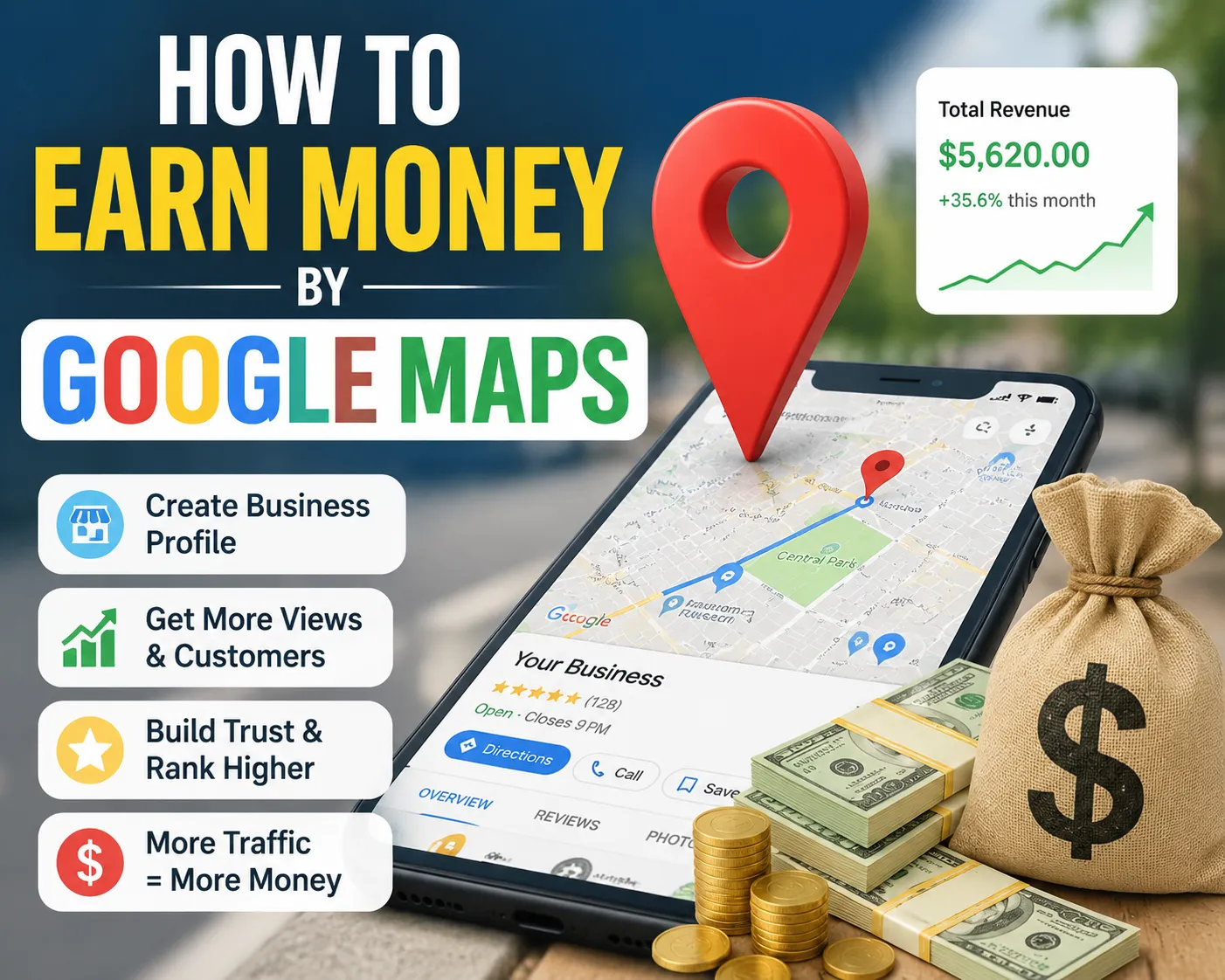
How I Started Earning Money Through Google Maps
I still remember the exact evening my cousin told me about this. We were sitting outside his place, drinking tea, and he casually mentioned that he had made a decent amount that month just by fixing Google Maps listings for local shop owners. I almost didn’t take it seriously. It sounded like one of those things people say to sound interesting at a family gathering. Then he pulled out his phone and showed me a payment he had received from a shop owner two localities away, and something shifted in my head that night.
For years, I had used Google Maps the same way most people do. Checking directions before a road trip. Looking up a restaurant’s rating before booking a table. Finding the nearest pharmacy at eleven at night when someone at home had a fever. I never once thought of it as something that could generate income. It took months of watching my cousin work on this before I actually understood what was going on behind the scenes.
The Problem Most Local Businesses Don’t Even Notice
While researching this for a small project I was working on, I found something that genuinely surprised me. A huge number of small business owners create their Google Maps listing once, during registration, and then never touch it again. No updates. No new photos. Sometimes the phone number listed is years old and no longer works.
I decided to test this myself before offering it to anyone as a service. I picked ten random local businesses in my area and checked their listings one by one. Out of those ten, six had incomplete information. Two had wrong business hours. One clothing store didn’t even have a single photo uploaded, just a gray placeholder icon where the storefront image should have been. That small experiment alone told me there was real demand for this kind of help, even if the business owners themselves didn’t realize they needed it.
A close example is my friend’s bakery. She had been running the place for almost two years, and her cakes were genuinely good, people who found her loved her work. But her shop rarely appeared when someone searched “bakery near me,” even for people standing just two streets away. I sat with her for an afternoon, cleaned up her business hours, added fresh photos of her cakes, wrote a short description that actually described what made her bakery different, and asked a handful of regular customers to leave reviews. Three weeks later, she told me her order calls had gone up noticeably. That was a small moment, but it stuck with me.
Starting Small as a Local Guide
Before I ever charged anyone money, I spent time as a Local Guide on Google Maps, which is basically Google’s own reviewer program. I began leaving honest reviews for places I visited anyway. A small clinic near my house. A tea stall I stopped at most mornings. A park where I used to go for walks.
There was no pressure attached to this. I wasn’t trying to earn anything at first, I was just documenting places I already knew. Over several months, the points added up, and I unlocked things like early access to new features and a couple of small perks, including extra cloud storage at one point. It wasn’t a huge financial reward by any measure, but it gave me a feel for how the review and ranking system actually worked, which turned out to be useful later.
One thing that became obvious after doing this for a while was that businesses with more recent, more detailed reviews tended to rank higher and appear more trustworthy to people searching. That single realization became the foundation of the service I eventually built.
Turning Knowledge Into an Actual Paying Service
After my experience with the bakery, I started reaching out to a few more local businesses. Nothing fancy, just simple messages explaining what I could do and showing before-and-after examples from the bakery project. A dentist near my old college replied first.
His listing had almost no information beyond a name and address. No photos of the clinic. No mention of the specific treatments he offered. I spent an evening reorganizing everything: added clear photos of the waiting area, listed his specializations, corrected his working hours, and set up a simple message template he could send patients asking for a quick review after their appointment. Within about six weeks, he told me his new patient inquiries had roughly doubled compared to the previous two months. He paid me for the work and referred me to a fellow dentist he knew from college.
Here is a simple comparison of what most unoptimized listings look like against ones that have been properly handled.
| Listing Element | Before Optimization | After Optimization |
|---|---|---|
| Business photos | Missing or blurry | Clear, well lit, regularly updated |
| Business hours | Outdated or incorrect | Accurate and current |
| Description | Empty or vague | Specific, keyword-friendly |
| Reviews | Few, old, or none | Steady stream of genuine feedback |
| Categories | Generic or wrong | Precise and relevant |
| Overall visibility | Inconsistent | Noticeably stronger in local search |
What Surprised Me Most Along the Way
I expected the writing and photo work to be the hardest part of this. It wasn’t. The hardest part was convincing business owners that their listing even mattered. Several people I approached genuinely believed that once their shop was on Google Maps, the work was done. Explaining that a listing needs ongoing attention, almost like a small garden that needs watering, took more effort than the actual optimization work itself.
Photography turned out to be more valuable than I initially assumed too. During a slow month, I offered free photography sessions to two cafes just to build a stronger portfolio. Both owners were hesitant at first, unsure why a stranger wanted to photograph their coffee cups and interior seating. Once they saw the finished images, though, one of them asked if I could also help with their Instagram page, which became a small side project of its own.
A Mistake I Made Early On
I want to mention this honestly, because it taught me something important. Early on, I encouraged a client to ask every single customer for a review, regardless of how their experience actually went. A few reviews came back mixed, some even slightly negative, and the client was upset with me. I realized afterward that pushing for volume without paying attention to genuine service quality can backfire. Reviews only help a business when the underlying experience is actually good. After that, I changed my approach and started advising clients to focus on service first, then reviews would follow more naturally.
Pros and Cons of This Kind of Work
Pros
- Very low starting cost, mostly your time and a decent phone camera
- Can be done part time alongside a regular job or studies
- Builds genuine, long term relationships with local business owners
- Skills improve quickly since every business has slightly different needs
Cons
- Income builds slowly at the start, sometimes for months
- Requires patience while convincing owners that this actually matters
- Results depend heavily on how consistent the business stays afterward
- A few clients may not understand the value until they see it themselves
Where This Has Taken Me So Far
What began as one afternoon helping my friend’s bakery slowly grew into a small, steady side income. I currently work with a handful of local businesses on a monthly basis, checking their listings, updating photos every few weeks, and helping them respond to reviews in a way that sounds genuine rather than robotic. None of this needed a big investment upfront. It needed patience, a willingness to learn how local search actually functions, and a genuine interest in helping small businesses get noticed by the people right around them.
Frequently Asked Questions
Q1. Do I need technical skills to start helping businesses with Google Maps?
Not really. A basic understanding of how listings work, a decent phone camera, and simple writing skills are usually enough to get started.
Q2. How long does it take to see real results after optimizing a listing?
From my experience, small improvements often show up within three to six weeks, though this varies depending on the business type, location, and how competitive the local market is.
Q3. Can this work alongside a full time job or studies?
Yes, most of the work, like uploading photos or writing descriptions, can be done during evenings or weekends without much scheduling conflict.
Q4. Should I charge money for my very first project?
Not necessarily. Offering the first project at a low cost or even free can help build trust, collect honest testimonials, and give you real examples to show future clients.
Q5. Are paid or fake reviews allowed on Google Maps?
No, paid or fake reviews go against Google’s policies and risk getting removed, along with possible penalties for the business. It is safer and far more sustainable to encourage genuine reviews from actual customers.
 Topic Person