
Etsy vs Gumroad: Which Platform Is Actually Better for Selling Digital Products?
Selling digital products sounds simple. Make something, upload it, get paid. But the moment you actually try to do it, the first real question hits you. Where do you even put it?
Two platforms come up over and over in this space. Etsy and Gumroad. Based on research across seller communities, forums, and documented experiences from people who have used both, here is a clear breakdown of how each one actually works and which one makes more sense depending on where you are right now.
Quick note before we get into it: fee percentages and platform policies shift over time. Whatever numbers I mention here are based on current publicly available information, but double-check the official sites before making any real decisions.
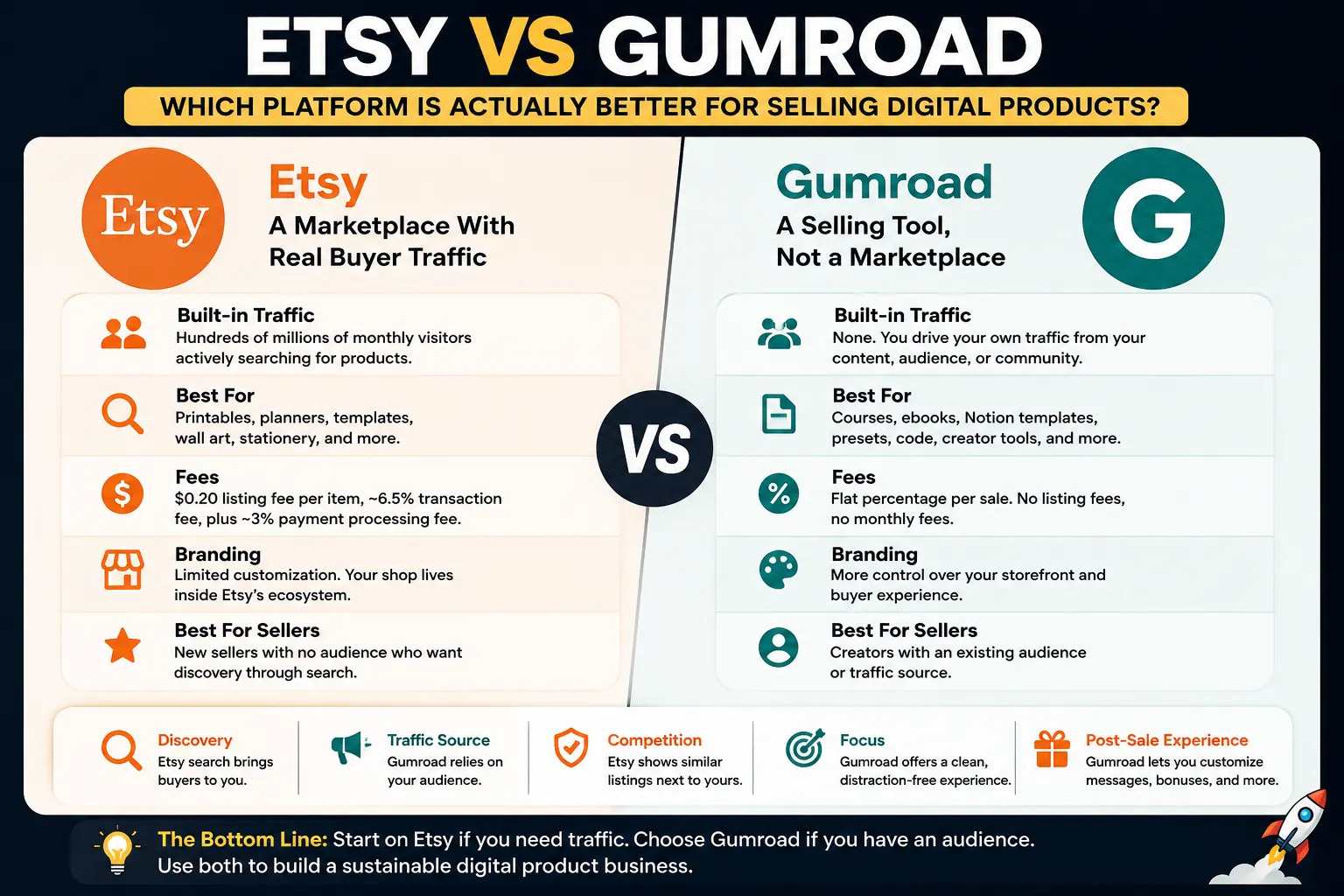
Etsy: A Marketplace With Real Buyer Traffic
Let me start with what actually makes Etsy valuable, because it is not what most people focus on.
Etsy gets hundreds of millions of visitors every month. Not random visitors either. People who open Etsy already have something in their heads they want to buy. They type “printable weekly planner” or “editable invoice template” into the search bar and start scrolling. The intent is already there before they see your product.
For a new seller with no following, no email list, and no social media presence, this matters enormously. You are not trying to build traffic. You are stepping into traffic that already exists.
Some sellers get their first sale within a week or two of listing on Etsy with zero promotion, though results vary depending on niche, pricing, and how competitive the category is. The point is that the opportunity exists from day one in a way it simply does not on Gumroad.
The trade-off is the fee structure. Etsy charges a small listing fee per product, a transaction fee on every sale of around 6.5%, and payment processing on top of that. On a $10 product, you might clear $8.30 or so after everything. Not terrible, but it stacks up as volume grows.
And your shop does not really feel like yours. Everything lives inside Etsy’s design system. Every seller page looks more or less the same. A buyer who purchases from you might honestly remember it as “that thing I bought on Etsy” rather than connecting it to you as a creator.
Best suited for: printables, planners, wall art, resume templates, budget trackers, wedding stationery, and anything visual where buyers search by product type.
How Etsy Search Actually Works
Most new sellers upload their product and then wonder why nobody is finding it. The listing title, the tags, the thumbnail. These three things determine whether Etsy’s search engine shows your product or buries it.
The title is the biggest factor. Etsy scans it from left to right, so whatever matters most goes at the beginning. “Minimalist Budget Planner PDF Printable, Weekly Finance Tracker, Instant Download” will pull more relevant searches than “Weekly Planner Minimalist.” The first one mirrors the way buyers actually search. The second one is how a designer thinks about their own product.
Tags work the same way. You get 13 of them, and each one should be a phrase, not a word. “Budget planner printable” is useful. “Planner” alone throws you into a pool with half a million other listings. Think about the full sentence someone might type when they need what you made.
Your description helps Etsy understand context. A few relevant phrases early in the description give the algorithm something to work with. This does not mean stuffing keywords in. It means writing naturally about what the product does and who it is for, which usually includes the right language anyway.
The thumbnail is the one people underestimate most. A listing that gets clicked tells Etsy that real buyers are responding to it, and that slowly improves where it shows up in search. Clean, high-contrast images with readable text in the preview consistently outperform busy or minimal thumbnails across categories.
One thing worth knowing: long-tail search terms convert better than short ones. “Editable pitch deck template for freelancers” gets fewer searches than “presentation template,” but someone typing that specific phrase is already close to buying. Broad terms bring window shoppers. Specific terms bring buyers.
New shops take time. Reviews and completed sales feed into rankings. The first month usually feels dead. That is not a sign that something is wrong.
Gumroad: A Selling Tool, Not a Marketplace
Gumroad works completely differently. There is no marketplace. No one opens Gumroad and browses for products to buy the way they browse Etsy. You create a product page, get a link, and then go find your own buyers.
The buyer experience on Gumroad is notably clean. Someone mentions a Notion template pack in a YouTube video and drops the link in the description. You click it, land on a page with one product, pay, download, and you’re done. No distractions, no sidebar showing other sellers, nothing competing for attention. The whole thing takes maybe 90 seconds.
That is what Gumroad is good at. When someone lands on your product page, it is just them and the product. No competitor listings sitting right next to yours.
The fee setup is straightforward. Gumroad takes a flat percentage per sale. No listing fees, no monthly cost just to have a store. The exact percentage is worth checking directly on their site since it has changed before, but the structure itself is clean and predictable.
The catch is simple and significant. You bring all the traffic yourself. No built-in search engine is going to surface your Gumroad page to strangers. Sellers who set up beautiful Gumroad stores and then did nothing else saw nothing happen. The page does not work on its own.
Works well for: ebooks, courses, Notion templates, Lightroom presets, code resources, writing guides, and any product where the creator’s personality is part of what people are buying.
Fees: What the Numbers Actually Look Like
Take the same scenario for both platforms. A $20 digital product, 100 sales in a month, $2,000 total revenue.
| Etsy | Gumroad | |
|---|---|---|
| Revenue | $2,000 | $2,000 |
| Listing Fees | ~$20 | $0 |
| Transaction Fee | ~$130 (approx 6.5%) | Varies |
| Payment Processing | ~$60 (approx 3%) | Included |
| Estimated Take-Home | ~$1,790 | Varies |
| Best Product Types | Printables, planners, templates | Courses, ebooks, creator products |
These numbers are examples, not guarantees. Platform fees change periodically, so verify the latest pricing directly from Etsy and Gumroad before calculating profit margins.
At $20 per product, the gap is small. Change that to a $5 printable, and Etsy’s per-listing fee becomes a bigger chunk proportionally before any other fees apply. Low-price products take a harder hit on Etsy.
High-ticket items work the other way. A $150 course means a notable chunk going to Gumroad on every single sale. Some sellers at that price point eventually look at Payhip or Lemon Squeezy. But for most people just starting out, both platforms are reasonable.
How People Actually Drive Traffic to Gumroad
Every Gumroad article says “you need an audience.” Almost none of them explain how to get one. Here is what actually works.
YouTube is the channel that comes up most when you look at successful Gumroad sellers. The pattern is consistent: create videos that genuinely teach something related to your product, and put the Gumroad link in the description. Someone who watched a 15-minute video where you helped them solve a real problem already trusts you. They are not a cold buyer. That trust converts.
Some of the most consistent Gumroad sellers have smaller audiences than you might expect. Channels with under 5,000 subscribers regularly generate steady sales when the videos directly relate to the product being sold. Size matters less than relevance.
Pinterest is worth knowing about for certain product types. It behaves more like a search engine than a social feed. A pin for a planner template or a Canva kit can keep pulling clicks for months. The visual format suits digital products well and the traffic does not disappear after 24 hours, the way an Instagram post does.
An email list sounds old-fashioned but it is still the most reliable thing. Even a small list of a few hundred people who actually want to hear from you can move product. The inbox does not have an algorithm filtering your message out. You write, it arrives.
A blog or content site takes longer but the results last. Articles that rank in Google for related topics send readers who are already interested in the subject. A natural product mention inside a useful article converts quietly but steadily.
X works for certain niches, mostly tech, design, writing, and online business. LinkedIn works better for anything professional, templates for work, career tools, business resources. Neither one gives instant results. Both reward showing up consistently without making every post a sales pitch.
The thread running through all of this: useful content first, product second. The link works when people already have a reason to trust what you made.
The One Question That Actually Matters
The fee discussion comes up in every comparison, but it is almost secondary. The real question is simpler.
Where is your traffic coming from today?
Not in six months. Not once you grow. Right now.
If the honest answer is nowhere, Etsy is the more practical starting point. The marketplace gives your listing a real shot at being found through search from day one. A reasonable title, relevant tags, a clean thumbnail. That combination can generate early sales without needing any followers. On Gumroad in the same scenario, almost nothing moves without traffic being sent deliberately from outside.
Flip it around. A creator with an active newsletter or a YouTube channel with even a few thousand subscribers can use Gumroad effectively from the start. Every email, every video description sends warm readers to a focused product page. No competing listings in sight. For that person, Gumroad makes more sense.
Your current assets decide the answer. Not which platform sounds better.
Branding and What Buyers Actually Experience
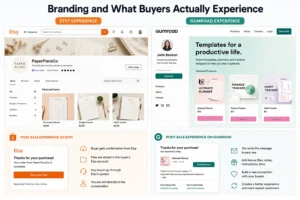
On Etsy your shop looks like every other Etsy shop. There is a banner space, a logo spot, a short bio. The listing pages all follow the same template. A buyer purchasing from you is really purchasing from inside Etsy’s environment. They might not even remember your shop name afterward.
Gumroad gives you a bit more personality. You can adjust colors, write a fuller description, build something that feels more distinctly like you. It is not a custom website but it is closer to having your own space. Repeat buyers start recognizing your name rather than just the platform.
The post-sale experience is where the difference is most obvious. On Etsy the buyer gets a confirmation from Etsy. The file is in their Etsy account. Any issue routes through Etsy’s system. You are not really in that conversation.
On Gumroad, you write the message they see right after checkout. You can add a bonus file, a personal note, instructions, a link to something helpful. The sellers who do this well tend to see buyers come back for a second purchase. Adding something small and unexpected in that confirmation message is one of the simplest things that makes a real difference in whether people remember buying from you specifically.
Why Using Both Together Works Better Than Picking One
Most comparison articles frame this as a choice. It does not have to be.
Etsy handles new buyer discovery. Strangers who have never heard of you find your product through search, buy it, leave a review. Your shop gains credibility. Some of those buyers find your other links, follow you somewhere, end up on your email list.
Gumroad runs in the background for your direct audience. Every newsletter you send, every video description, every social post goes to your Gumroad page. The buyers there already know you. No marketplace environment competing for their attention.
Over time the Etsy buyers who liked your work start finding you elsewhere. Some subscribe. Some eventually buy directly through Gumroad the next time. Your dependence on Etsy’s search algorithm gradually decreases.
A common pattern among successful sellers is that many start with Etsy to get cash flow and real product feedback, then expand to Gumroad once they have something to promote it with. Doing both simultaneously from zero usually means neither gets enough attention to gain traction.
Full Platform Comparison
| Feature | Etsy | Gumroad |
|---|---|---|
| Built-in Traffic | Yes, large marketplace | None, you drive your own |
| Listing Fee | $0.20 per item | None |
| Transaction Fee | Approx 6.5% | Flat rate (check current) |
| Payment Processing | Approx 3% extra | Included in flat fee |
| Best Product Types | Printables, planners, templates | Courses, ebooks, creator tools |
| Branding Control | Limited | Moderate |
| Competitor Listings Shown | Yes, right next to yours | No |
| Post-Sale Customization | Limited | Flexible |
| Best For | New sellers, no audience yet | Creators with existing traffic |
| Discovery System | Etsy search | None built in |
Who Should Choose Etsy and Who Should Choose Gumroad?
This is the part most people actually came here for.
Choose Etsy if you have no existing audience and want a platform that brings buyers to you through search. You do not need a following. You do not need to run ads. A well-set-up listing in a category people actively search can start generating sales on its own.
Choose Gumroad if you already create content and have people who follow your work. A newsletter, a YouTube channel, a blog, or even a modest social media account counts. The product link works when there is already a relationship behind it. If you are also thinking about how to sell digital products without investment, Gumroad fits naturally into that approach since it has no upfront costs.
Use both if you want marketplace discovery running in the background while also building a direct customer relationship. Etsy handles strangers finding you. Gumroad handles the audience you build over time. Many sellers also explore other platforms to sell digital products once they have momentum on one of these two.

Frequently Asked Questions (FAQs)
Q1. Can I run both Etsy and Gumroad at the same time?
Yes, and plenty of sellers do. Etsy brings in new buyers through search. Gumroad handles sales to your existing audience. They serve different situations rather than competing with each other.
Q2. Does Etsy actually support digital products like PDFs and templates?
Yes. Digital downloads are a proper category on Etsy. Once someone pays, the file goes out automatically through Etsy’s system. Nothing manual on your end.
Q3. Do either of these platforms handle taxes for you?
Etsy handles sales tax collection for sellers in many regions automatically. Gumroad manages VAT for certain international transactions. But tax situations vary depending on where you live and where your buyers are. Neither platform covers everything, so it is worth looking into your local rules once money starts coming in regularly.
Q4. Which is cheaper for products priced under $5?
Gumroad tends to work out better for very cheap products. Etsy’s per-listing fee is a flat amount that becomes a larger percentage of the sale the lower your price is. Gumroad’s percentage-based structure stays proportional regardless of price.
Final Thoughts
Neither platform is the right answer for everyone.
Etsy gives you access to buyers who are already looking. The fees are layered, and your brand gets somewhat absorbed into the marketplace, but that existing search traffic is hard to recreate from nothing. For someone starting out with no audience and wondering how to get started in e-commerce, Etsy is genuinely one of the lower-friction paths available.
Gumroad gives you a cleaner experience and more control over how you present yourself and communicate with buyers. The limitation is that you have to bring your own traffic, which means having somewhere to send people from. Building content through freelancing or content writing is one way sellers create that foundation before launching a product.
The thing most people miss: Etsy and Gumroad are not really competing for the same seller. Etsy is where strangers find you. Gumroad is where your actual audience buys from you. They solve different problems.
If you are brand new with no following, start on Etsy. Build some sales, get some feedback, and understand what buyers actually want. If you already have traffic coming from content you make, Gumroad gives you more control and a stronger long-term foundation.
And if you are still reading this instead of uploading your first product, that is the real problem. Both platforms are free to start. Pick the one that fits where you are right now.
 Topic Person