

How to Start Freelancing and Actually Earn: A Beginner’s Honest Guide
Most freelancing articles tell you to “build a portfolio” and “set competitive rates.”
That advice is not wrong. It is just incomplete.
Nobody tells you that your first Fiverr gig might sit at zero orders for twelve days. Nobody warns you that the first client who responds might try to expand the scope after you have already submitted the work. And nobody prepares you for how demoralizing it feels to refresh the dashboard and see nothing again.
This guide covers the full picture. Practical steps, realistic timelines, and what actually separates freelancers who figure it out from those who quit after six weeks.
You can also explore “8 Best Freelancing Websites | Low Competition.”
What Freelancing Actually Means
Freelancing means selling a specific skill to different clients on a project-by-project basis.
No single employer. No fixed salary. You set the rate, choose the work, and operate from wherever focus is possible.
The range of services freelancers sell online is wider than most beginners expect:
- Copywriting and blog writing
- Short-form video editing
- Web development
- Translation and transcription
- Data entry and research
- Social media management
- Virtual assistance
And dozens of narrower specializations within each of those.
One thing worth understanding before starting: this is not passive income. It is self-employment. The freedom is real but nobody fills your schedule when things go quiet. Nobody chases payments on your behalf.
Why People Choose Freelancing
- No income ceiling. Raising rates or taking on better clients directly increases monthly earnings. No performance review required.
- Location independence. Work from a home desk, a rented apartment, or a café, wherever concentration is actually possible.
- Skill-based entry. No degree required. Clients care about what you deliver, not where you studied.
- Currency advantage. A freelancer in Pakistan, Bangladesh, or the Philippines earning in US dollars or Euros commands significantly stronger local purchasing power than local salaries typically offer. Real advantage. Not a small detail.
The honest caveat: freelancing income is inconsistent early on. Planning for that financially before starting removes a lot of unnecessary pressure.
Realistic Timeline: How Long Does It Take?
Weeks 1–2: Setup Phase
- Build profiles on Fiverr or Upwork
- Create portfolio samples
- Send first proposals
- Zero income for most people is normal
Weeks 3–6: First Response Phase
- First replies and messages appear
- Possibly a first order
- Earnings are usually between $0 and $150
- Some freelancers land a client here. Many do not
Months 2–4: Momentum Phase
- Reviews start accumulating
- Repeat clients begin appearing
- Part-time freelancers can reach $200 to $600 per month
Months 6–12: Growth Phase
- Consistent reviews and reliable delivery
- Around 20 hours per week can realistically reach $800 to $2,000 monthly
- Developers and designers often exceed this range
These are realistic ranges, not guarantees. Speed depends on skill demand, proposal quality, and willingness to adjust when something is not working.
Best Freelancing Skills to Start With Right Now
Lower Barrier Easier to Begin
- Short-form video editing (Reels, Shorts, TikToks)
- Data entry and online research
- Transcription and captioning
- Virtual assistance and inbox management
- Basic graphic design using Canva
Medium Difficulty and Higher Earning Potential
- Copywriting and blog writing
- SEO content writing
- Podcast editing
- WordPress website setup
Higher Skill Strongest Long-Term Earning
- Web and app development
- UI/UX design
- Technical writing
- Paid advertising management
Start with a skill you already have. A competent beginner at something mid-range will outperform someone mediocre at a “high-value” skill in almost every early situation.
You also learn “How to earn money by Content Writing: A Beginner’s Honest Guide.”
How to Get Your First Freelancing Client
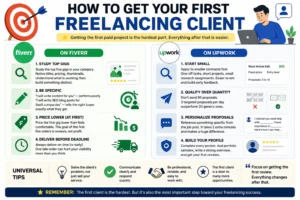
Getting the first paid project is genuinely the hardest part. Everything after that is easier.
On Fiverr
Study the top five gigs in your category. Notice titles, pricing, thumbnails. Understand what is working then build something distinct.
- “I will write content for you” — performs poorly
- “I will write SEO blog posts for SaaS companies” tells the right buyer exactly what they get
One beginner copywriter rewrote her gig three times before the first order arrived. The change that worked was replacing “content writer” with “blog writer for finance websites.” Same skill. Same person. Completely different result.
Price the first gig lower than what feels comfortable. The goal of the first five orders is reviews, not profit.
On Upwork
Apply to smaller contracts first. One-off tasks, brief editing jobs, small research assignments. Easier to win and they build the first visible feedback on the profile.
Most beginners think sending 50 proposals helps. Usually it just burns Connects and demoralizes faster.
Three targeted proposals per day outperform twenty generic ones. Always referencing something specific from the job post takes two extra minutes and makes an immediate difference.
How to Build a Portfolio With No Experience
No experience is not the blocker that most beginners think it is.
Clients want proof of ability. They do not care how that proof was created.
Here is what actually works:
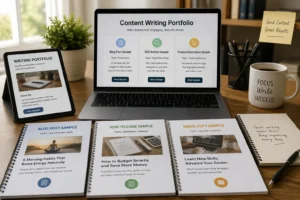
Create sample projects. Write three blog posts on topics in your niche. Edit a short video using free footage. Design a mock logo for a fictional brand. These demonstrate skill without requiring a paid client.
Offer discounted work early on. Some freelancers take one or two projects at a reduced rate specifically to generate a real portfolio piece and a genuine testimonial. Not ideal long-term — but effective as a starting point.
Use personal projects. A YouTube channel, a blog, a social media page any real output counts as portfolio evidence. Even if it was made for yourself.
Showcase process, not just results. A short explanation of what the goal was, what approach was used, and what the outcome was makes any portfolio piece stronger. Clients want to understand how you think.
The portfolio does not need to be large. Three strong, specific samples in a clear niche are more convincing than ten generic ones.
Navigating Fiverr

Fiverr works on a Gig system. Sellers list defined packages with fixed prices, delivery times, and revision limits. Buyers browse and order directly no lengthy interview required.
What Actually Works on Fiverr
Go specific with your niche.
“Video editing for real estate agents” converts better than “video editing for any business.” Less competition. Higher match rate.
Invest in the thumbnail.
Many buyers decide whether to click based on the thumbnail before reading a single word. Clean, readable, easy to understand at small size. This detail gets ignored far too often.
Keep introductory pricing temporary.
Many beginner video editors start at $10 to $15 per clip to collect reviews, then move toward $35 to $50 as the profile builds. That rate increase will not happen automatically it has to be decided and executed deliberately.
Deliver before the deadline. Every time.
One late order affects visibility more than most sellers expect. The algorithm tracks this quietly.
Navigating Upwork

Upwork connects freelancers with larger, often multi-month projects. Clients post detailed briefs. Freelancers submit proposals and compete for the contract.
Understanding the Job Success Score
The platform uses a Job Success Score (JSS) as a public metric.
- Above 90% — strong profile visibility, more interview requests
- Dropping below 80% — noticeably fewer opportunities
Protecting that score matters more than maximizing contract volume. One poorly handled project can drop it in a way that takes months to recover.
What Actually Works on Upwork
Complete every profile section.
Photos, headlines, bios, portfolio samples and clients evaluate all of this silently before reading any proposal. Incomplete profiles get skipped without a second thought.
Filter searches aggressively.
Exclude:
- Unverified payment methods
- Very low budgets
- Clients with no hiring history or reviews
Low-quality projects are not worth the time especially when income is slow and the temptation to accept anything is highest.
Write proposals that feel personal.
- One direct sentence addressing the client’s specific problem
- Brief description of the approach
- One specific question about the project
- Under 200 words total
Clients on Upwork care more about clear, fast communication than perfectly formal English. A quick, clear reply wins more contracts than flawless grammar with a 48-hour response time.
A Real Failure Moment
The profile was complete. The gig was live. Title specific. Pricing competitive. Description covered everything.
Nine days. Nothing.
The easy conclusion is that the skill is wrong or the platform does not work. That conclusion is almost always wrong and almost every beginner reaches it anyway.
What needed changing was the thumbnail. Too text-heavy. Too dark. Looked identical to a dozen other gigs in the same search results.
A simpler version was uploaded. Clean background, one clear line, readable at small size. The first order came five days later. It was $15 for a short blog post outline. Not impressive. But it was the first review and everything moved differently after that.
The problem was never the skill. It was one image.
How Freelancers Receive Payments
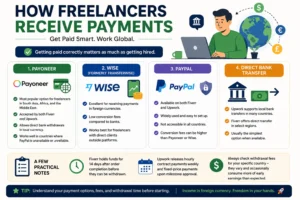
Getting paid correctly matters as much as getting hired.
Most popular option for freelancers in South Asia, Africa, and the Middle East. Accepted by both Fiverr and Upwork. Allows direct bank withdrawals in local currency. Works well in countries where PayPal is unavailable or unreliable.
Wise (formerly TransferWise)
Excellent for receiving payments in foreign currencies with low conversion fees. Works best for freelancers with direct clients outside platforms.
PayPal
Available on both Fiverr and Upwork. Widely used but not accessible in all countries. Conversion fees can be higher than Payoneer or Wise.
Direct Bank Transfer
Upwork supports local bank transfers in many countries. Fiverr offers direct transfer in select regions. Usually the simplest option when available.
A few practical notes:
- Fiverr holds funds for 14 days after order completion before they can be withdrawn
- Upwork releases hourly contract payments weekly and fixed-price payments upon milestone approval
- Always check withdrawal fees for your specific country they vary and occasionally consume more of early earnings than expected
Best Free Tools for Freelancers
No budget needed to start. These free tools cover almost everything a new freelancer requires:
For creating work:
- Canva — Graphic design, presentations, thumbnails, portfolio layouts
- ChatGPT — Research assistance, brainstorming, first drafts to work from
- DaVinci Resolve — Professional video editing at no cost
For staying organized:
- Notion — Client notes, project records, contract details
- Trello — Deadline tracking across multiple clients
- Google Workspace — Shared documents and real-time client collaboration
For communication and professionalism:
- Grammarly — Writing quality check before any client-facing message
- Calendly — Client scheduling without back-and-forth emails
- Loom — Short video updates for clients in different time zones
For tracking time and money:
- Toggl Track — Time logging for hourly contracts
- Wave — Free invoicing and basic income tracking
All free tiers. All genuinely useful from day one.
Industry Statistics Worth Knowing
- According to Upwork’s 2023 Freelance Forward Report, approximately 59 million Americans performed freelance work in 2023 around 36% of the U.S. workforce
- Statista’s 2023 Freelance Market Data places the average hourly rate across all Upwork categories at approximately $28, with experienced specialists frequently earning $75 to $150 per hour
- Freelancers who respond within one hour receive measurably more orders than those with response times above 24 hours
Charging $8 per hour for skilled work does not signal affordability. It signals inexperience — and attracts the most demanding, lowest-budget clients on the platform.
Mistakes Beginners Make
1. Sending Generic Proposals
“I am a skilled professional with extensive experience” appears in thousands of proposals daily. Clients skip it. Reference the specific job post and propose a concrete approach instead.
2. Underpricing With No Plan to Raise Rates
Starting low makes sense. Staying low indefinitely does not. Decide the trigger for the first rate increase five reviews, ten completed orders before accepting the first project. Before. Not after.
3. Depending on One Platform Only
Accounts get suspended. Algorithms shift without warning. A freelancer with a LinkedIn presence, a direct client or two, and a basic personal website is far more stable than someone whose entire income runs through a single marketplace.
4. Ignoring Tax Obligations
Payments arrive with no tax withheld. Set aside 25 to 30 percent of every payment from the beginning. Easy to delay. Consistently regretted.
5. Slow Response Times
A client who messages three freelancers and gets one reply within an hour almost always goes with that person regardless of price or profile strength. Response speed is underrated, especially early on.
How to Avoid Burnout as a Freelancer
Burnout is real in freelancing and more common than most guides acknowledge.
The pressure of finding clients, delivering work, managing communication, and handling finances simultaneously is genuinely demanding. A few habits make a meaningful difference:
Set working hours and keep them. Freelancing does not mean being available at all hours. Defined start and end times protect energy over the long term.
Limit the number of active clients. Two or three clients handled well is more sustainable than five handled poorly. Quality of delivery suffers when spread too thin.
Take proper breaks. This sounds obvious. Most freelancers ignore it until the quality of their work starts dropping and they cannot figure out why.
Separate work space from rest space. Even a dedicated corner of a room creates a mental boundary between working and not working. The line matters.
Review workload monthly. What felt manageable three months ago might be too much now or too little. Adjusting regularly keeps the workload honest.
Burnout does not announce itself early. The warning signs are usually subtle slower response times, less care in deliverables, reluctance to open the laptop. Catching it early is much easier than recovering from it fully.
Warning Signs of Scam Clients
Moving off-platform immediately. Requests to switch to WhatsApp or personal email before any contract is signed frequently precede payment avoidance.
Vague scope with urgent pressure. “Just start and we will sort out the details” is a setup for scope creep and payment disputes. Confirm details before any work begins.
Multiple free samples requested. One short sample is reasonable. Three full deliverables “to test skills” is unpaid work with a polite justification attached.
No reviews, no payment verification, no hiring history. Not an automatic disqualifier but worth significant caution before committing time.
Conclusion
Most freelancers do not fail because they lack skill.
They fail because they quit during the invisible phase — when no one replies, no one clicks, and nothing seems to move.
That phase is not a signal that freelancing does not work. It is the period before the algorithm surfaces a new profile and before buyers have enough evidence to trust one. Getting through it is the actual barrier to entry.
If you are starting freelancing this month: focus on getting the first review rather than chasing high income immediately. That first client changes how the profile looks to every buyer who visits after. It also changes how the whole process feels.
The skill was never the hardest part.

Frequently Asked Questions
Q1. Is Fiverr oversaturated right now?
Depends on the category, honestly. Broad niches like “logo designer” or “blog writer” — yes, those are crowded. But “email writer for e-commerce brands” or “video editor for real estate agents”? Much less so. The platform is not the problem. Offering the same thing as everyone else is.
Q2. How long does it take to get the first order on Fiverr?
Realistically, anywhere from three days to four weeks. If nothing arrives within two weeks, something needs adjusting — usually the thumbnail, the title, or the delivery time. Change one thing at a time so it is clear what actually made the difference. Changing everything at once just creates confusion.
Q3. Is Upwork better than Fiverr for beginners?
Depends on how you like working, honestly. Fiverr suits people who want to list a fixed service and wait for buyers to come. Upwork suits people comfortable writing proposals and chasing specific projects. Neither is universally better. A lot of beginners try both early on and naturally gravitate toward one.
Q4. How much can a beginner realistically earn in the first three months?
For most people working part-time somewhere between zero and $500. Month one is usually the slowest. The first order rarely pays well. But that first review matters more than the money anyway, because it changes how the profile looks to every buyer who visits after that.
Disclaimer
The information shared in this article is based on personal research and general experience. I have written this article to help people who are genuinely looking to learn not to make any guarantees about results or earnings.
Everyone’s situation is different. What works for one person may not work the same way for another so please use your own judgment before making any decisions based on what you read here.
Some of the tools, platforms, or methods mentioned in this article may change over time. I do my best to keep things accurate but I can’t guarantee that every detail stays up to date forever.
This article is for informational purposes only and it is not professional financial, legal, or business advice. If you’re making serious decisions, especially around money or business, please consult a qualified professional.
If there are any affiliate links or sponsored mentions in an article, they will be clearly disclosed. I only recommend things I genuinely believe are useful.
Thanks for reading, and I hope you found something valuable here.
Found this guide useful? Share it with someone who is considering starting to freelance. And if you have a question about getting started drop it in the comments. Real questions get real answers.
 Abdullah Waheed